
Archives
-
Media influences, algorithms, cultures
No. 17 (2025)INTRODUCTION
The 17th issue of Medialog magazine is entitled “Media Influences, Algorithms, Cultures” and provides a platform for 12 researchers from five academic institutions – Sofia University St. Kliment Ohridski, the University of National and World Economy, the National Academy for Theatre and Film Arts “Krastyo Sarafov,” the Bulgarian Academy of Sciences, and the National Center for Infectious and Parasitic Diseases. The three thematic circles set out in the title do not encapsulate the texts in separate units, but create internal links that play a key role in understanding current issues in the contemporary communication environment. The media are increasingly suffering from negative phenomena such as segmentation, fragmentation, and polarization of society. These effects can be exacerbated by artificial intelligence algorithms in digital communication. Is it possible for television and radio to contain some fields for different understandings of “culture” that we can rely on in our conversations.
The theme “Media influences, algorithms, cultures” brings together research on the strong politicization of media content during the COVID-19 pandemic (Dr. Zhivka Getzova), the online struggle for offline justice (PhD student Emil Enev), artificial intelligence and deepfake content as a threat in times of crisis of media trust (Dr. Desislava Sotirova), algorithms as a risk of standardization and depersonalization of contemporary pop music (Dr. Mihail Lukanov), the contributions of culture to public life and dialogue on leading Bulgarian television channels (Dr. Vesislava Antonova), and the relationship between language, media, and culture (PhD student Viktoria Lekova).
This issue of Media Log also includes a review by Prof. Ventsislav Dimov of the collection The Power of Cinema: An Anthology of Bulgarian Film Thought Between the Two World Wars. The book is part of the research project “Cinema Culture, Arts, and National Images in Bulgaria” and contains 120 texts, which Prof. Dimov describes as a ‘chrestomathy’ and “the crown of film memory.” The book Charlie Chaplin on Vitosha: The Formation of Film Culture in Bulgaria and the Balkans between the World Wars was also published as part of the same project. In his review, Dr. Peter Aylov emphasizes the curious story behind the film of the same name, which aims to draw the attention of world cinema to the Balkan scene. Mediolog magazine attempts to trace key events in academic life and cover books related to media and culture. Viktor Chulev presents Dr. Silvia Petrova's book New Media and Post-Truth, in which the main thesis is that the threat to truth is not so much lies and manipulation as the risk of losing its meaning.
Assoc. Prof. Ema Konstantinova presents Dr. Nikolay Yordanov's book Dramaturgical and Production Aspects in Reality Talent Shows, which can serve as a handbook for anyone who wants to take a peek behind the scenes of popular television productions.
In the “Academic Life” section, you will find reviews of two important events for the Faculty of Journalism and Mass Communication at Sofia University “St. Kliment Ohridski”: The International Scientific Conference “Communication in Times of Global Crises,” which marked the 30th anniversary of the establishment of the “Public Relations” major and of the department itself, and the Festival of the Department of Radio and Television and School Media, organized by Assoc. Prof. Dr. Zhana Popova and doctoral students Lora Tarkoleva and Viktor Chulev, in which over 25 school media outlets from across the country participated for the first time. Enjoy reading!
Zhanna Popova
Nikolay Kolev
-
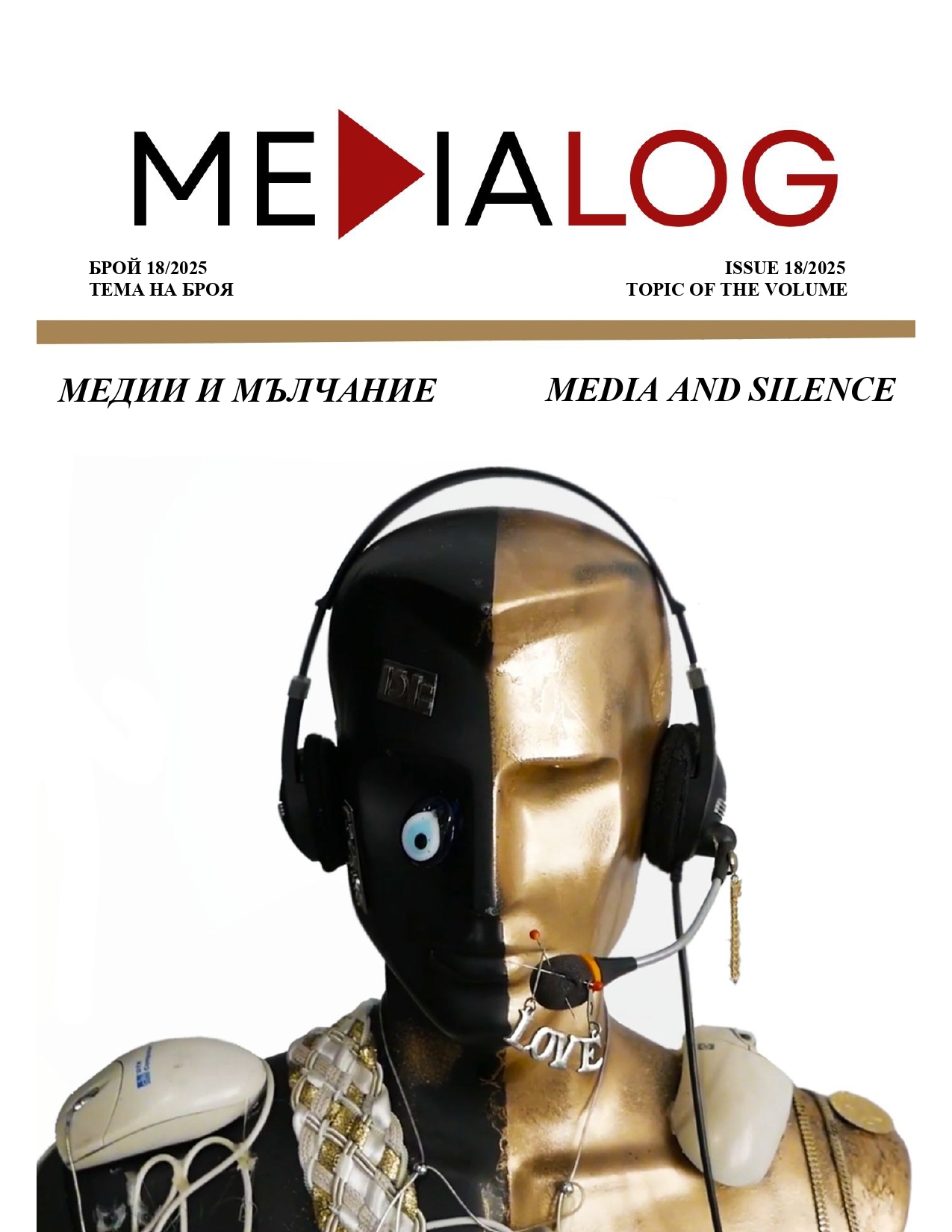
Media and Silence
No. 18 (2025)We are witnessing crises, wars, conflicts of interest, lobbying, and networks of dependency, while attempts to silence diverse voices continue. For a long time, the word silence accurately described public attitudes – silence stemming from dependency, insecurity, sadness, social pressure, or a sense of helplessness and despair. Over the past decade, however, a gradual yet unmistakable shift from passivity toward new forms of public expression has emerged. This tendency is visible both in global movements such as MeToo and in the 2025 Miss Universe contest. At the same time, in 2025 we saw large-scale public protests triggered by growing intolerance toward corruption and contentious budgetary policies in several countries, including France, Spain, Bulgaria, Mexico, Peru, Nepal, Kenya, Madagascar, Serbia, and the Philippines.
Thus, the period dominated by silence is slowly giving way to one marked by impatience and a desire for justice. Here, the role of the media is essential—whether they choose to report facts or speculate with them.
This issue of Mediolog brings together texts from the 10th National Scientific Conference “Media and Silence,” organized by the Department of Radio and Television and held from 17–19 September 2025 in the town of Kazanlak. The forum featured doctoral students as well as prominent scholars and lecturers from Sofia University “St. Kliment Ohridski,” New Bulgarian University, and the Bulgarian Academy of Sciences.
The issue opens with a text by Strahil Delijski, who analyzes the main aspects of theoretical debates on the “silent majority” and the crisis in political communication. In her study, Ralitsa Kovacheva examines how conservative media supported by political power influence journalism in the United States. Desislava Sotirova continues the discussion with an analysis of Donald Trump’s communication strategy toward American media and his attempts at intimidation through institutional tools and legal action.
Nikola Venkov-Rose draws attention to shifts in paradigms within mass communication research, shaped by the varying importance attributed to propaganda in different historical periods.
Yosif Astrukov guides readers into the world of fiction, analyzing the dark predictions of a television series that mirrors contemporary reality – just one step ahead – Black Mirror.
We also present reviews of two academic publications: Svetla Koleva’s reading of Digitalization of Love: In Search of the Intimate Other by Nia Neykova, and Svetla Tsankova’s review of Media and Politics: Intertwining and Influence by Iliya Valkov.
In the second issue of 2025, we also include Petya Aleksandrova’s commentary on reports about the Chernobyl nuclear disaster and the silence of the Bulgarian authorities regarding its consequences.
The “Cultural Life” section offers a summary of the second joint exhibition by Ventsislav Dimov and Orlin Spasov, held at the Kazanlak Art Gallery, Detchko Uzunov House-Museum Branch (27 August – 12 November 2025).
This issue of Mediolog is published with the support of project 80-10-1 / 23.05.2025 of Sofia University “St. Kliment Ohridski.”
From the issue’s editor:
Chief Assistant Professor Dr. Desislava Sotirova

-
Media: Voices and Echoes
No. 19 (2026)Thе topic Media: Voices and Echoes emerged from a conversation we began at the Tenth National Scientific Conference Silence and Media, organized by the Radio and Television Department at the Faculty of Journalism and Mass Communication, Sofia University “St. Kliment Ohridski”. In 2025, in Kazanlak, we framed the directions of this conversation on media voices as an invitation to authors intrigued by the intersections between media and technology; by the trajectories of media usages (social, cultural, economic, political, ideological); by the syntheses of media means and content: the voice as a physical phenomenon and communication tool in traditional media, the voices and echoes in the “retorts” of digital media laboratories, and the echo of the echo in the discourses of media studies…
This issue’s articles are the result of diverse reflections. They outline several areas of inquiry, united by the theme Media: Voices and Echoes. The texts draw on approaches and conceptual frameworks from various social sciences and fields: media and communication studies, journalism, cultural studies, philosophy, and law.
Georgi Lozanov reflects on The Problem of Authorship in Works Created by Artificial Intelligence and seeks answers to some of the current challenges posed by ChatGPT. Lozanov extends Foucault’s thoughts on the question What is an author? to the realm of large language models, particularly in cases where the generated works are indistinguishable from those created by humans. He agrees with Chomsky that the AI Chabot plagiarizes from humans in order to maintain a previously unimaginable “multidimensional space” of texts and to extract from them interpretations that await their authors.
Orlin Spassov explores the specific nature of media voices and their resonance within the dynamics of a single research subject (Sega) and its online content. The text Moderation on the Sega Newspaper Forum reconstructs the history of the media outlet’s forum by analyzing the connection between moderation and changes in the publication’s policies, the roles of moderators and forum participants, and the effects of their actions. Among Spassov’s contributions are his examination of the forum as a subject “closed” to the public and researchers, as well as his identification of the reasons that led to the forum’s decline and subsequent disappearance.
In her article Youth Is (Not) a Vice on TikTok: The 2026 Election Campaign of Gen Z Candidates, Lora Simeonova follows the latest political developments and ongoing media buzz. The article examines the communication strategies of five Gen Z candidates on the “social network for young people” during Bulgaria’s most recent race for parliament. It analyzes the significance of performative authenticity, platform adaptation, and politainment in Gen Z’s political communication. Simeonova’s empirical data show that there is no direct correlation between algorithmic visibility, user engagement, and electoral success.
Alexandar Nikolov’s text is also prompted by algorithmic intermediation, but also by commercial incentives that alter The Visibility of Public Interest Content Online as a Task of EU Law. The author highlights the need for visible journalistic content of public interest in today’s digital environment so that the media can serve as “public watchdogs”. The publication examines regulatory documents and mechanisms developed in response to this challenge. Nikolov draws on the evolution of the understanding of public interest in philosophy and media studies.
By combining the anthropology of music and the anthropology of media, two authors seek the answer(s) how one “actor” positions himself on various media stages and what roles the diverse participants play in the media spectacle. The integral linking the two texts is Volodya “Voyvodata” Stoyanov.
In the first article, Musical Voices and Media Echo: On the Media Image of a Singer, Ventsislav Dimov outlines the artist’s multifaceted media image, with an emphasis on current digital platforms related to hybridization, transmedia tools, and hybrid content. Stoyanov’s images are categorized both by media type and by the position of the message’s initiator and the new media audiences. The study highlights the role of social media as a global music accelerator and the growing significance of short-form digital content on Instagram and TikTok.
On Some Ambiguities in a Media Image, reflects Lozanka Peycheva, continuing her interpretations of the image of “Voyvodata”, focusing on the constructions “from the inside” (primarily through the singer’s personal website) and the ones “from the outside” (through his parodic alter ego on a TV show). The constructed media image of Volodya Stoyanov as a singer-preacher, Peycheva argues, embodies a long process of postmodern reconciliation and unification of seemingly incompatible phenomena, such as pop (folk) culture and Christian revelation.
The interest of the last two authors in media music is also shared by Emil Yachovski in the Student Works section. His article, Politics, Media and Music. Cancel Culture and the Eurovision Song Contest, draws attention to certain political and ideological functions of media voices and their echoes. Yachovski examines the Eurovision Song Contest as a kind of geopolitical arena for battles between different voices, mobilizing the “echo” of the revived Intervision, the Russian alternative to the European music competition.
In the Reviews and Academic Life sections, our “scientific radar” picks up on both recently published works and a recent academic conference.
Nikolay Kolev presents the volume Video Games: Between Creativity and Industry, edited by Vyara Angelova, Zhana Popova, and Snezhana Popova. The book summarizes the results of a series of research projects conducted between 2022 and 2025 on the development of the gaming sector in Bulgaria and its transition from a product of contemporary digital culture to a specific communication environment.
Panayot Stefanov’s text Authority Even in Times of Post-Truth presents the volume Liber Amicorum in Honor of Prof. Nelly Ognyanova, highlighting the structure, thematic areas, and scholarly contributions across its three constituent parts.
Lozanka Peycheva’s review, Spoken and Written, Read and Remembered, is of Ancho Kaloyanov’s Spoken and Written. A Collection of Articles with Dedications, which features the author’s articles spanning the intersecting fields of the humanities: ethnology and folklore studies, medieval and Slavic studies, as well as the history of literature and literary criticism, each of which is dedicated to figures significant to him from the academic, teaching, media, and creative spheres.
Ana Todorova-Damova summarizes the results of the National Round Table University Academic Journals in the Field of Media and Communications – Current Issues and Prospects. Thirty participants from 11 institutions discussed the need for publication standards adequate to the Bulgarian scientific tradition, the difficulties in meeting the requirements for inclusion in various databases, effective indexing, fake information, the role of artificial intelligence in the editorial and publishing process, and so-called “paper mills”.
Last but not least in terms of its contribution to the dialogic nature of Media: Voices and Echoes is Lora Tarkoleva’s text In Memoriam: Rock Is Unmatched Beauty, a Burst of Energy, and a Sense of Total Freedom. An Interview with Ivan Milev – Vacho. The conversation with “Little Bundarak” (1944 – 2025), one of the pioneers of Bulgarian rock 'n' roll, took place a year before his death. We recall him as an echo of a time when this music held “magical power” for the young people of that era (the baby boomers). Testimonies from that time are heard less and less often, reverberating like a fading echo rather than striking like thunder.
Each of the texts here finds its own media voice, creating a polyphonic sound. One of the issue’s positive features is that it brings together diverse authors – including established scholars in the social sciences and humanities, young researchers, university professors, doctoral candidates, and students. Another valuable trait is the dialogic nature of the theme, which is open to readers as well. Perhaps, given the up-to-date and thought-provoking issues outlined and the proposed interpretations, our conversation – which began in Kazanlak – will spark further reflection, and even responses. There are many media voices; our interpretations are voices as well, not merely – and not so much – echoes. They help us avoid falling into the situation of the mythological nymph Echo: doomed to lose her own voice and to repeat only the words of the others...
We won’t lose our way, will we?
Ventsislav Dimov and Lora Tarkoleva