
Archives
-
Media influences, algorithms, cultures
No. 17 (2025)INTRODUCTION
The 17th issue of Medialog magazine is entitled “Media Influences, Algorithms, Cultures” and provides a platform for 12 researchers from five academic institutions – Sofia University St. Kliment Ohridski, the University of National and World Economy, the National Academy for Theatre and Film Arts “Krastyo Sarafov,” the Bulgarian Academy of Sciences, and the National Center for Infectious and Parasitic Diseases. The three thematic circles set out in the title do not encapsulate the texts in separate units, but create internal links that play a key role in understanding current issues in the contemporary communication environment. The media are increasingly suffering from negative phenomena such as segmentation, fragmentation, and polarization of society. These effects can be exacerbated by artificial intelligence algorithms in digital communication. Is it possible for television and radio to contain some fields for different understandings of “culture” that we can rely on in our conversations.
The theme “Media influences, algorithms, cultures” brings together research on the strong politicization of media content during the COVID-19 pandemic (Dr. Zhivka Getzova), the online struggle for offline justice (PhD student Emil Enev), artificial intelligence and deepfake content as a threat in times of crisis of media trust (Dr. Desislava Sotirova), algorithms as a risk of standardization and depersonalization of contemporary pop music (Dr. Mihail Lukanov), the contributions of culture to public life and dialogue on leading Bulgarian television channels (Dr. Vesislava Antonova), and the relationship between language, media, and culture (PhD student Viktoria Lekova).
This issue of Media Log also includes a review by Prof. Ventsislav Dimov of the collection The Power of Cinema: An Anthology of Bulgarian Film Thought Between the Two World Wars. The book is part of the research project “Cinema Culture, Arts, and National Images in Bulgaria” and contains 120 texts, which Prof. Dimov describes as a ‘chrestomathy’ and “the crown of film memory.” The book Charlie Chaplin on Vitosha: The Formation of Film Culture in Bulgaria and the Balkans between the World Wars was also published as part of the same project. In his review, Dr. Peter Aylov emphasizes the curious story behind the film of the same name, which aims to draw the attention of world cinema to the Balkan scene. Mediolog magazine attempts to trace key events in academic life and cover books related to media and culture. Viktor Chulev presents Dr. Silvia Petrova's book New Media and Post-Truth, in which the main thesis is that the threat to truth is not so much lies and manipulation as the risk of losing its meaning.
Assoc. Prof. Ema Konstantinova presents Dr. Nikolay Yordanov's book Dramaturgical and Production Aspects in Reality Talent Shows, which can serve as a handbook for anyone who wants to take a peek behind the scenes of popular television productions.
In the “Academic Life” section, you will find reviews of two important events for the Faculty of Journalism and Mass Communication at Sofia University “St. Kliment Ohridski”: The International Scientific Conference “Communication in Times of Global Crises,” which marked the 30th anniversary of the establishment of the “Public Relations” major and of the department itself, and the Festival of the Department of Radio and Television and School Media, organized by Assoc. Prof. Dr. Zhana Popova and doctoral students Lora Tarkoleva and Viktor Chulev, in which over 25 school media outlets from across the country participated for the first time. Enjoy reading!
Zhanna Popova
Nikolay Kolev
-
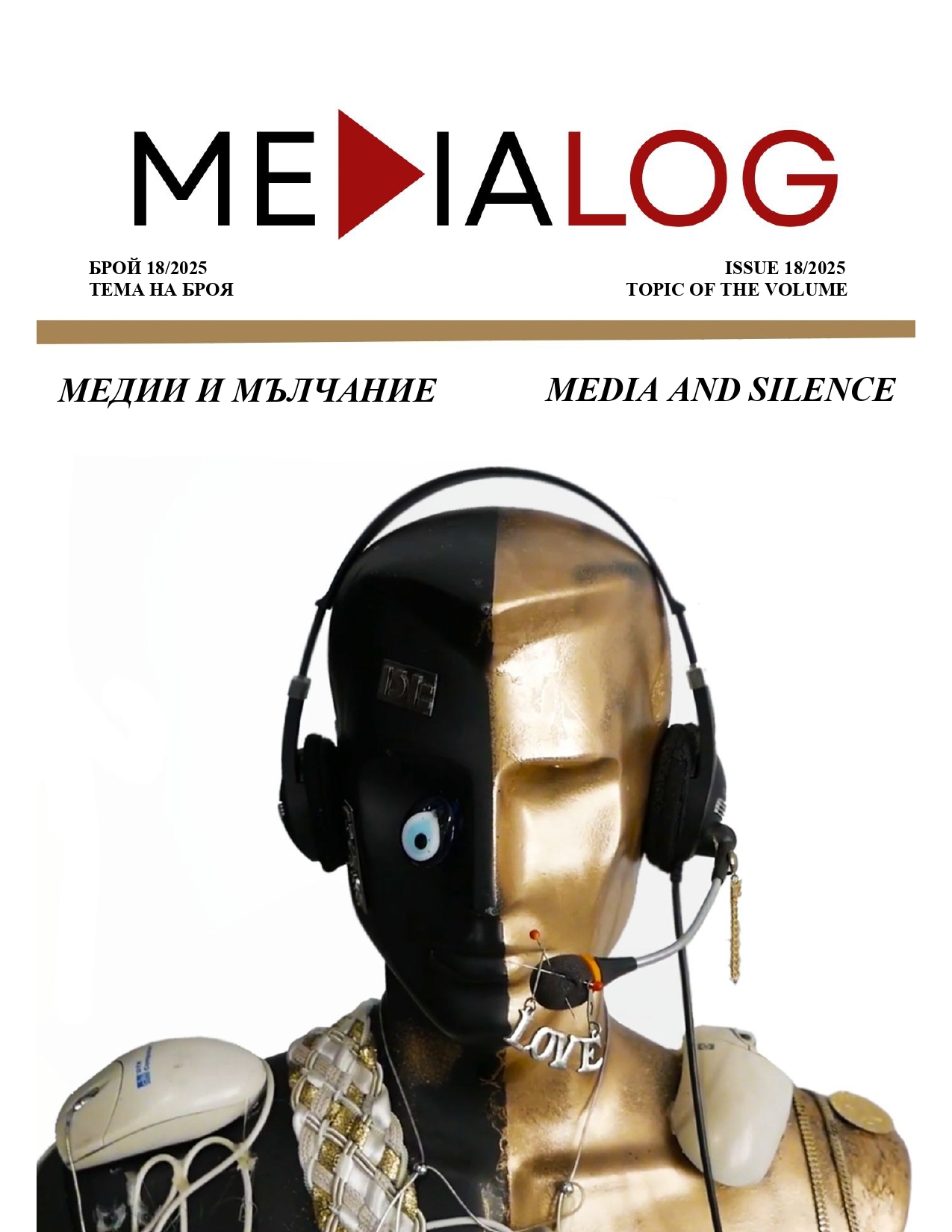
Media and Silence
No. 18 (2025)We are witnessing crises, wars, conflicts of interest, lobbying, and networks of dependency, while attempts to silence diverse voices continue. For a long time, the word silence accurately described public attitudes – silence stemming from dependency, insecurity, sadness, social pressure, or a sense of helplessness and despair. Over the past decade, however, a gradual yet unmistakable shift from passivity toward new forms of public expression has emerged. This tendency is visible both in global movements such as MeToo and in the 2025 Miss Universe contest. At the same time, in 2025 we saw large-scale public protests triggered by growing intolerance toward corruption and contentious budgetary policies in several countries, including France, Spain, Bulgaria, Mexico, Peru, Nepal, Kenya, Madagascar, Serbia, and the Philippines.
Thus, the period dominated by silence is slowly giving way to one marked by impatience and a desire for justice. Here, the role of the media is essential—whether they choose to report facts or speculate with them.
This issue of Mediolog brings together texts from the 10th National Scientific Conference “Media and Silence,” organized by the Department of Radio and Television and held from 17–19 September 2025 in the town of Kazanlak. The forum featured doctoral students as well as prominent scholars and lecturers from Sofia University “St. Kliment Ohridski,” New Bulgarian University, and the Bulgarian Academy of Sciences.
The issue opens with a text by Strahil Delijski, who analyzes the main aspects of theoretical debates on the “silent majority” and the crisis in political communication. In her study, Ralitsa Kovacheva examines how conservative media supported by political power influence journalism in the United States. Desislava Sotirova continues the discussion with an analysis of Donald Trump’s communication strategy toward American media and his attempts at intimidation through institutional tools and legal action.
Nikola Venkov-Rose draws attention to shifts in paradigms within mass communication research, shaped by the varying importance attributed to propaganda in different historical periods.
Yosif Astrukov guides readers into the world of fiction, analyzing the dark predictions of a television series that mirrors contemporary reality – just one step ahead – Black Mirror.
We also present reviews of two academic publications: Svetla Koleva’s reading of Digitalization of Love: In Search of the Intimate Other by Nia Neykova, and Svetla Tsankova’s review of Media and Politics: Intertwining and Influence by Iliya Valkov.
In the second issue of 2025, we also include Petya Aleksandrova’s commentary on reports about the Chernobyl nuclear disaster and the silence of the Bulgarian authorities regarding its consequences.
The “Cultural Life” section offers a summary of the second joint exhibition by Ventsislav Dimov and Orlin Spasov, held at the Kazanlak Art Gallery, Detchko Uzunov House-Museum Branch (27 August – 12 November 2025).
This issue of Mediolog is published with the support of project 80-10-1 / 23.05.2025 of Sofia University “St. Kliment Ohridski.”
From the issue’s editor:
Chief Assistant Professor Dr. Desislava Sotirova