Archives
-
Urban Nature
No. 30 (2025)“Why nature, then? First, it is already here.” (Ditchev, 2005: 98)
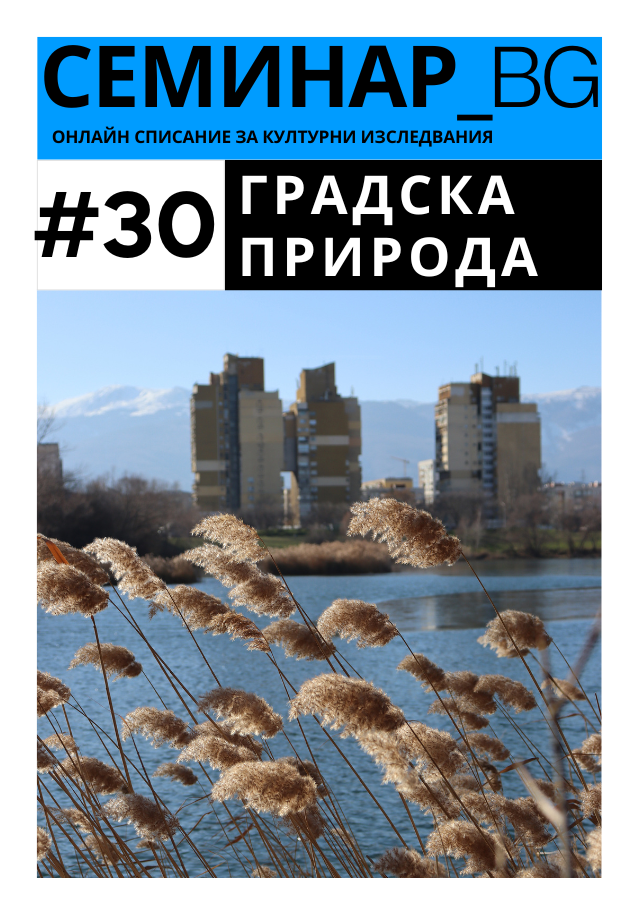
This issue of Seminar_BG is dedicated to urban nature – or rather, to nature in and around cities, the environment in which we live. Urban nature is a misleading term, as it can be understood as the essence of the urban, the natural state, or the inherent characteristics of urbanization. This issue distances itself from the naturalization of the historical progress of settlements. It also departs from the search for inherent urban characteristics and the presentation of a set of features as “natural”. Following the ideas of Descola and Ingold, the theme of this issue would more properly be termed the urban environment rather than urban nature, since the concept of nature can only be used by a being that succumbs to the illusion that it does not belong to it. Cities are among those spaces in which the ontology of naturalism is most visible and most difficult to overcome. Where should we begin in order to see buildings, roads, neighborhoods, and infrastructure as the environment of our own and other species? The crack in the pavement where a plant has taken root, the old lamp in which a tit has built its nest – these are the spaces and events in the urban environment where other forms of life actively define and reformulate the environment. The urban nature sought in the pages of this issue is the ecological dynamics of the city, expressed not only in what lies beyond the social, but as a dynamic between physical and social environments, human and non-human inhabitants. The authors examine this dynamic through specific cases – urban gardens in public spaces, the creation or loss of green areas, and the cultivation of endemic species.
Radoslava Kuneva, Guest Editor
-
Special Issue dedicated to prof. Ivaylo Ditchev
No. 29 (2025)“Ivaylo was the most insatiably curious person in the world (…)” With these words of Petya Kabakchieva, we would like you to welcome you to this special issue. “He always discovered detail, strangeness, an inversion of the usual in close and distant, unknown or supposedly familiar incidents, phenomena, events, people; he constantly saw things invisible to or unnoticed by us, his colleagues and friends.” (see Petya Kabakchieva, “About Ivaylo, the unorthodox…” in the section “About Ivaylo” at www.seminar-bg.eu)
As wide open and free roaming was Ivaylo’s research curiosity, so was our call for papers for the current issue that we would like to dedicate to him. Some of the texts were presented at the conference “Pop Culture, Pop Politics – the Digital Turn. Interdisciplinary Analyses of the Intersections between Media, Cultures and Politics”, also in loving memory of Prof. Ivaylo Dichev (October 4–5, 2024, Sofia, Faculty of Journalism and Mass Communication). Other texts we received in the following months. We did not seek to find a topic that could encompass all the texts in this issue. The unifying link has always been Ivaylo – the eternally searching, the impatient, the insightful, the extraordinary.
As insatiable as his curiosity was, so was his proverbial ability to get lost, especially while doing fieldwork. And if you too get lost in this issue – in the labyrinth of historical periods, themes and topics – then we believe that by doing so we have given you the opportunity to experience (or recollect) how it felt to work and communicate with Ivaylo, to follow his curiosity, to search together with him, to get lost in the wealth of ideas.
Niya Neykova and Valentina Georgieva
Editors of the issue
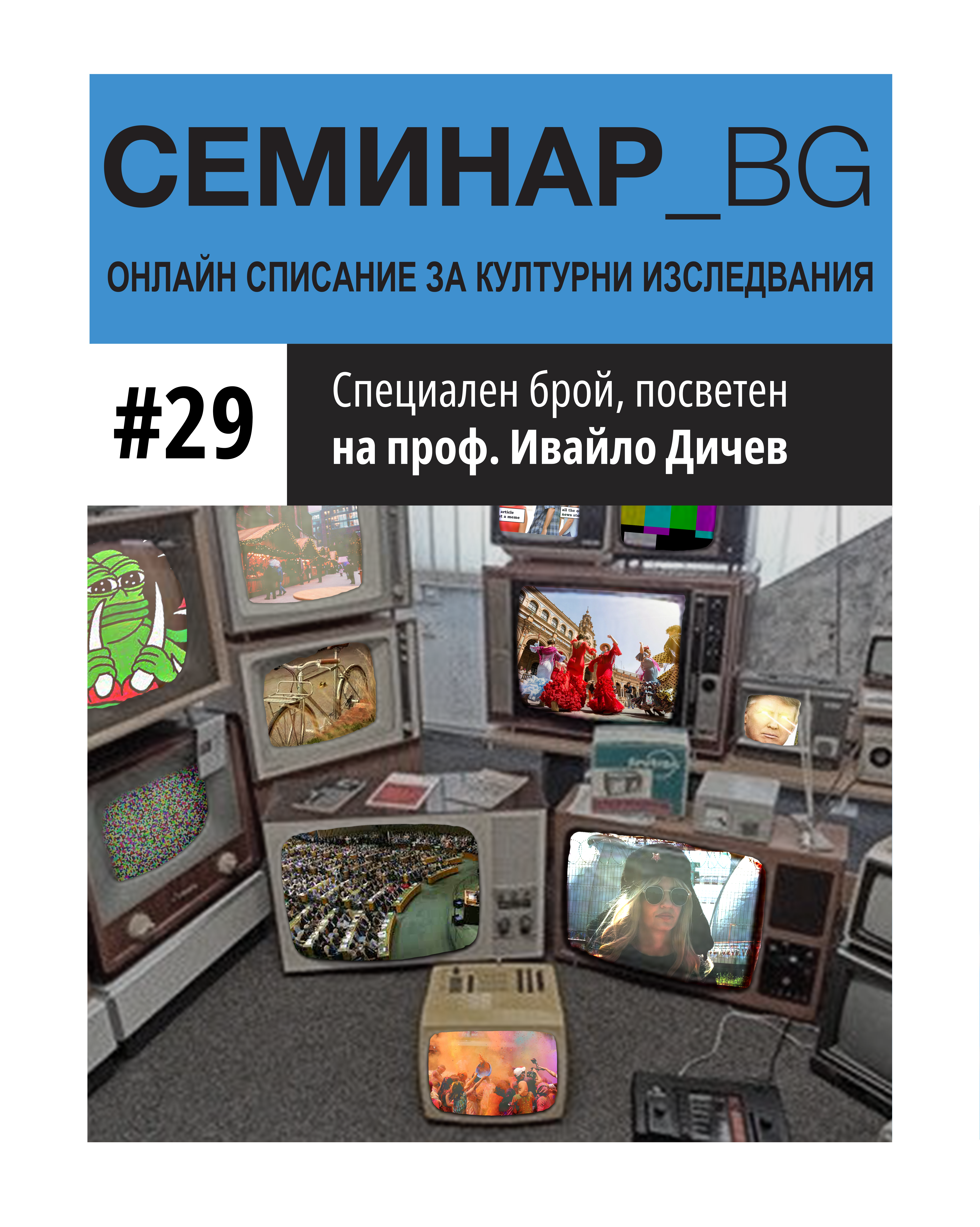
Cover design: Mina Ditcheva
The current issue 29 of SEMINAR_BG would not be possible without the financial support of the project "Pop Culture, Pop Politics: The Digital Turn. Interdisciplinary Analyses of the Intersection between Media, Cultures and Policies" (2021–2025), funded by the Bulgarian National Science Fund within the framework of the National Program "Fundamental Research", contract number H55/2, 15.11.2021.
-
The Musical Accompaniment of Politics
No. 26 (2023)Would you follow a leader who offers you a piece of music instead of a program? Don't rush to answer! Because from the dawn of human civilization, along with ideas, politicians have sought to master our emotions, and in this endeavor, music has its reserved place - from ritual to military march, from celebration to mourning. It has run like this up to this day: music channels the anger of protest, the identity experiences of the native land, the disgust of the opponent's "chalga". The issue aims to discuss those non-rational aspects of politics that political science usually underestimates. It is an element of a broader study on the relationship between pop culture and pop politics.
Editors: Ivaylo Dichev, Ventsislav Dimov
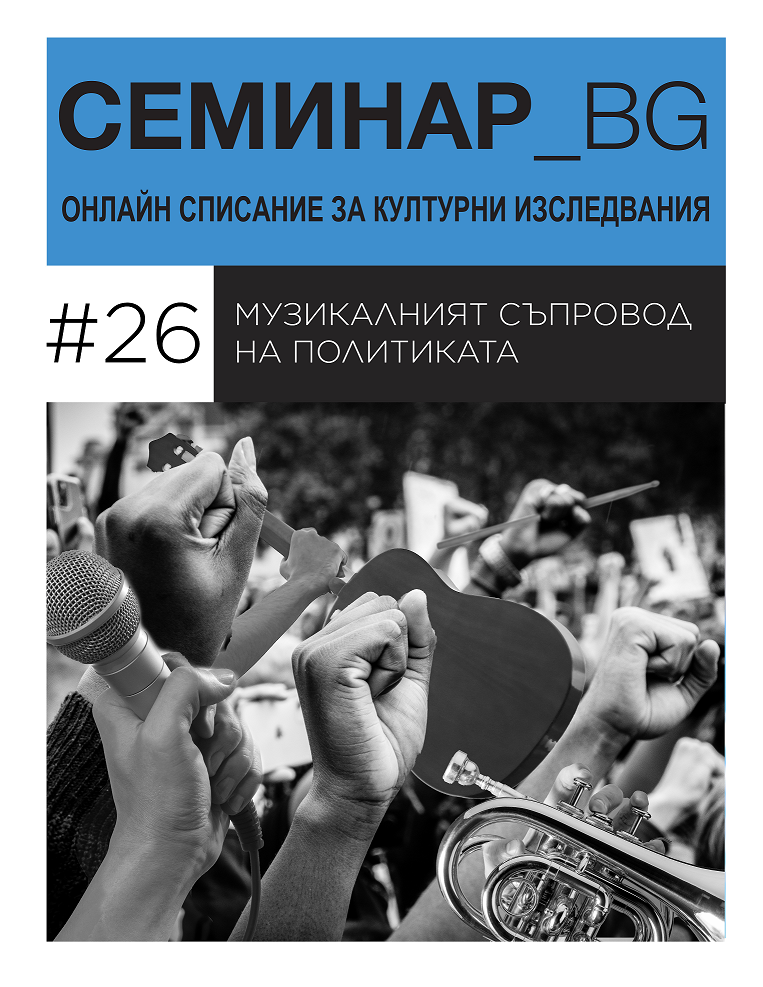
Cover artist: Mina Dicheva
Issue 26 of Seminar_BG is published within the framework of the research project "Pop Culture, Pop Politics: The Digital Turn. Interdisciplinary Analyses of the Intersection between Media, Cultures and Politics", implemented by scientists from the Faculty of Journalism and Mass Communication and the Faculty of Philosophy of Sofia University "St. Kliment Ohridski" and the Institute of Philosophy and Sociology at the Bulgarian Academy of Sciences, with the financial support of the FNI-MES, contract No. H55/2 of 15.12.2021.