Introduction
DOI:
https://doi.org/10.60054/SBG.2025.30.3-12Abstract
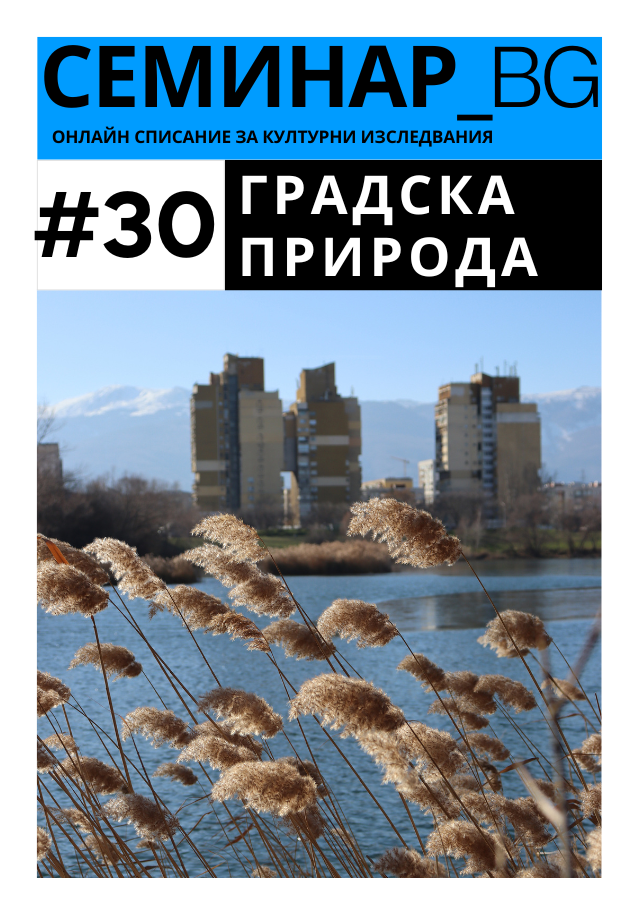
This issue of Seminar_BG is dedicated to urban nature – or rather, to nature in and around cities, the environment in which we live. Urban nature is a misleading term, as it can be understood as the essence of the urban, the natural state, or the inherent characteristics of urbanization. This issue distances itself from the naturalization of the historical progress of settlements. It also departs from the search for inherent urban characteristics and the presentation of a set of features as “natural”. Following the ideas of Descola and Ingold, the theme of this issue would more properly be termed the urban environment rather than urban nature, since the concept of nature can only be used by a being that succumbs to the illusion that it does not belong to it. Cities are among those spaces in which the ontology of naturalism is most visible and most difficult to overcome. Where should we begin in order to see buildings, roads, neighborhoods, and infrastructure as the environment of our own and other species? The crack in the pavement where a plant has taken root, the old lamp in which a tit has built its nest – these are the spaces and events in the urban environment where other forms of life actively define and reformulate the environment. The urban nature sought in the pages of this issue is the ecological dynamics of the city, expressed not only in what lies beyond the social, but as a dynamic between physical and social environments, human and non-human inhabitants. The authors examine this dynamic through specific cases – urban gardens in public spaces, the creation or loss of green areas, and the cultivation of endemic species.
References
Descola, P. (2013). Beyond nature and culture. Chicago: University of Chicago Press.
Ditchev, I. (2005). Prostranstva na zhelanieto, zhelaniya za prostranstvo. Sofia: Iztok-Zapad.
Dimitrova, P. (2025). Digitalno nomadstvo i vrazka s prirodata: primeri ot grad Bansko. Seminar_BG, 30, 163–185.
Draganova, I. (2025). Morskata gradina v Burgas mezhdu brand na grada i konstrukt na lokalna identichnost: Gradskata priroda kato ideologiya, myasto, pamet. Seminar_BG, 30, 30–61.
Gandy, M. (2022). Natura urbana: Ecological constellations in urban space. Cambridge: MIT Press.
Georgiev, K. (2025). Ekopateki v syankata na kombinata: traektorii na prirodata v postindustrialen Iztochen Sibir. Seminar_BG, 30, 135–162.
Haase, D., Dushkova, D., Haase, A., & Kronenberg, J. (2017). Green infrastructure in post-socialist cities: Evidence and experience from Eastern Germany, Poland and Russia. In T. Tuvikene, W. Sgibnev, & C. Neugebauer (eds.), Post-socialist urban infrastructures. Abingdon: Routledge.
Hunold, C. (2017). Why not the city? Urban hawk watching and the end of nature. Nature and Culture, 12(2), 115–136. https://doi.org/10.3167/nc.2017.120202
Ingold, T. (2000). The perception of the environment: Essays on livelihood, dwelling and skill. (2002 ed.). Taylor & Francis e-Library.
Kaneva, R. (2024). Zelenoto nasledstvo na balgarskite gradove. In I. Kabakov (ed.), Kulturnata pamet na grada (pp. 120–147). Universitetsko izdatelstvo “Sv. Kliment Ohridski”.
Karadzhov, V. (2025). Gradski ekopark „Badelema“ – badeshte (ne)vazmozhno. Seminar_BG, 30, 62–104.
Kartsellin, V. (2025). Gradskite ugari: teritorii na vaobrazhenieto i zabravata. Seminar_BG, 30, 13–29.
Mabey, R. (1973). The unofficial countryside. London: Collins.
Smith, N. (2006). Foreword. In N. Heynen, M. Kaika, & E. Swyngedouw (eds.), In the nature of cities: Urban political ecology and the politics of urban metabolism. Taylor & Francis e-Library.
Steel, W., & Maller, C. (2019). More-than-human cities: Where the wild things are. Geoforum, 106, 411–415.
Wang, J. (2024). Reimagining the more-than-human city: Stories from Singapore. Cambridge: MIT Press.
References
Downloads
Published
Issue
Section
License
Copyright (c) 2025 Seminar_BG

This work is licensed under a Creative Commons Attribution-NonCommercial-NoDerivatives 4.0 International License.