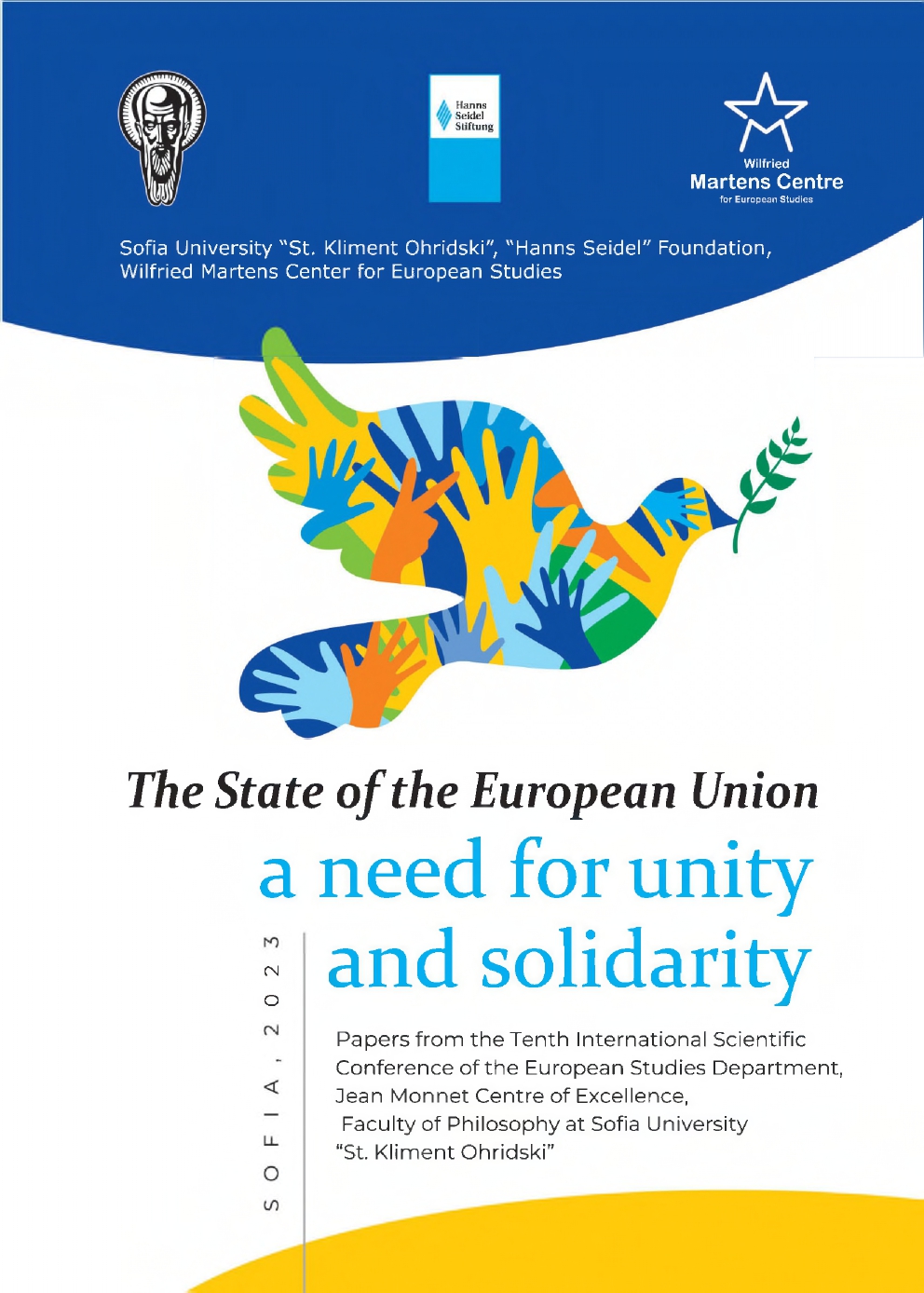
European industry reorganisation
an important factor for the EU single market development
DOI:
https://doi.org/10.60054/PEU.2023.10.30-39Keywords:
European Union Single market, European industries, EU economy and trade during the pandemic crisis of COVID 19, New Industrial Strategy, Green industries and digitalisationAbstract
The EU Single Market (SM) is a further stage of deepening EU integrity, of economic and trade integration. The EU SM is also a new stage of industrial development in the pursuit of achieving the double transition towards green economy and digitalisation. This objective is developed in the context of Europe becoming the first climate-neutral continent by 2050. Achieving the double transition, which is particularly important for the further evolution of European industry, is a task that requires the identification of major risks, which ought to be eliminated in order to strengthen European industries and the functioning of the Single Market. The development of new mechanisms and policies in the field of the new technologies implementation are needed for the successful double transition towards ecological friendly and innovative industries. The main idea of this article is the strengthening of the EU SM and the introduction of new industrial policies for transforming the real economic base and facilitate the double transition goals as well as the reforms on the SM.
References
Allenbach-Ammann, J. (2022, Jun 28), European businesses lament fragmentation of the EU Single Market. EURACTIV.
Brenton, P., Ferrantino, M. J., & Maliszewska, M. (2022). Reshaping Global Value Chains in Light of COVID-19: Implications for Trade and Poverty Reduction in Developing Countries. World Bank.
Christova-Balkanska, I. (2023). Bulgarian and Romanian industrial potential in the European Single Market. Single Market at 30, Coordinator E. Dijmarescu, Academia Romania, Institutul Nat,ional de Cercetà∪ri Economice “Costin C. Kirit,escu”, Insitutul de economie mondiala, p.79-108.
EIB Investment Report 2021-2022, Recovery as a springboard for change, The EIB annual report on Investment and Investment Finance.
EU industrial structure. A publication prepared by The Directorate General for Enterprise and Industry Unit B2 “Competitiveness and Economic Reforms”.
European Industrial Strategy, European Commission. https://ec.europa.eu/info/strategy/priorities-2019-2024/europe-fit-digital-age/european-industrial-strategy_en
europa.eu. https://energy.ec.europa.eu > topics > hydrogen_en
GDP at regional level. (2022, May), Eurostat Statistics explained.
Gereffi, G. (2020). What does the COVID-19 pandemic teach us about global value chains? The case of medical supplies. Journal of International Business Policy, 3(3), p.287-301.
https://commission.europa.eu/strategy-and-policy/recovery-plan-europe_en.
https://www.eib.org/en/publications-research/economics/surveys-data/eu-overview-2021.htm.
Key figures on European business, (2023 Edition), Eurostat.
La Commission europå ́enne publie une mise `à jour de la stratå ́gie industrielle de l’UE (2021, 25 mai). Rå ́publique franñ, aise.
L’Union europåenne: combien a-t-on gagnå ́ à la faire (et combien perdrait-on à la då ́faire)? (2018, Juin), La Lettre de CEPII (Centre d’å ́tudes prospectives et d’informations internationales) N° 389.
Szczepanski, M., & Ragonnaud, G. Future shocks (2022), Establishing greater strategic autonomy for European industry. European Parliamentary Research Center.
Vervey, M., & Monks, A. (2021, 21/10), The EU economy after COVID 19: Implications for economic governance. CEPR.